Introduction to Low-Code Development & FlutterFlow Overview (2026 Guide)

Low-code software engineering is transforming how modern digital applications are built. Instead of handcrafting every line of boilerplate code from scratch, forward-thinking engineering teams and founders use visual interfaces, reactive widget trees, and pre-engineered cloud connectors to build high-performance applications in a fraction of traditional timelines.
In this comprehensive guide, we examine the fundamental concepts of low-code development, explore how FlutterFlow fits into the global technology ecosystem, compare traditional software development with low-code architectures, and outline the exact pipeline required to take an application from concept to the App Store.
1. What is Low-Code Development?
Low-code development is a software construction paradigm that utilizes visual interfaces, component hierarchies, and visual logic flow builders to assemble web and mobile applications. Unlike pure "no-code" platforms that restrict builders to fixed templates, enterprise low-code platforms allow engineers to inject custom code (Dart, JavaScript, Python, SQL) whenever business logic exceeds out-of-the-box components.
Traditional Development vs. Low-Code Development
| Evaluation Dimension | Traditional Custom Development | Low-Code (FlutterFlow Architecture) |
|---|---|---|
| Development Velocity | 4 to 9 months for first MVP release | 3 to 8 weeks for production launch |
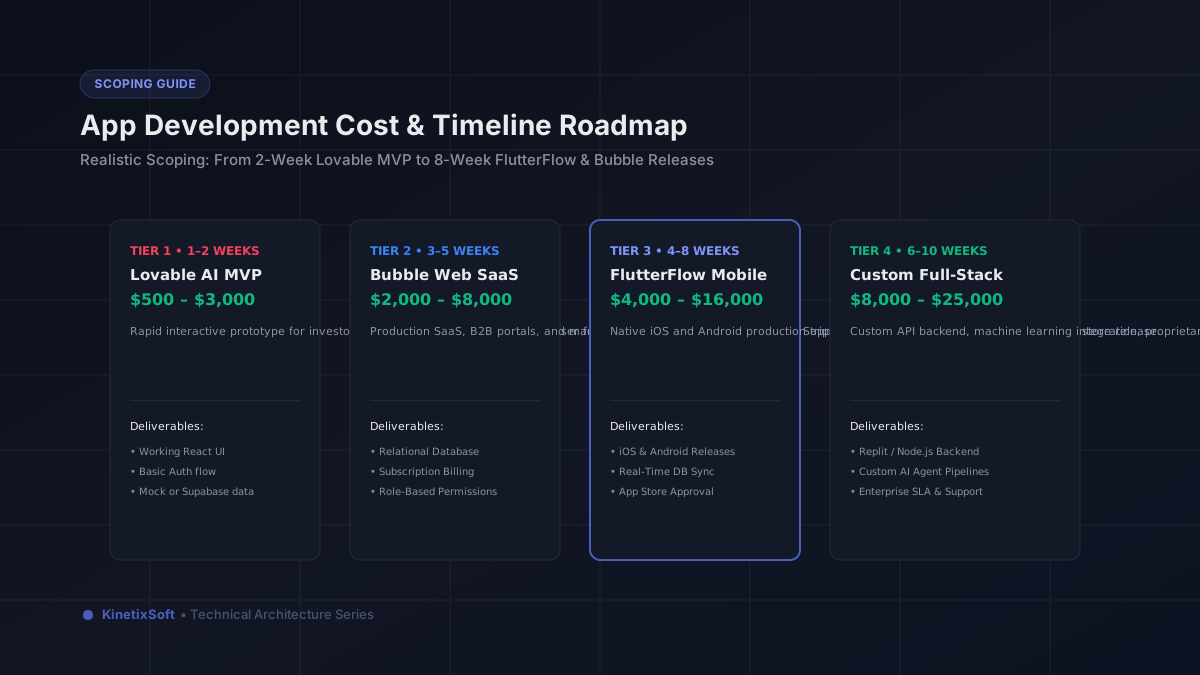
| Cost Capital Required | $80,000 to $200,000+ | $10,000 to $35,000 (60–75% savings) |
| Code Ownership & Portability | 100% owned source code | 100% clean Google Flutter (Dart) export |
| Rendering Performance | Native GPU compilation (60–120 FPS) | Google Impeller Engine native 120 FPS |
| Maintenance & Updates | High ongoing maintenance cost | Visual UI updates + modular custom actions |
2. Why Low-Code Development is Dominating in 2026
The global shift toward low-code platforms is driven by market realities: venture capital demands faster product-market fit validation, engineering talent costs remain elevated, and consumer expectations for polished mobile experiences are higher than ever.
- Rapid Market Validation: Launch a functional product to real users in weeks rather than spending two quarters in design committee meetings.
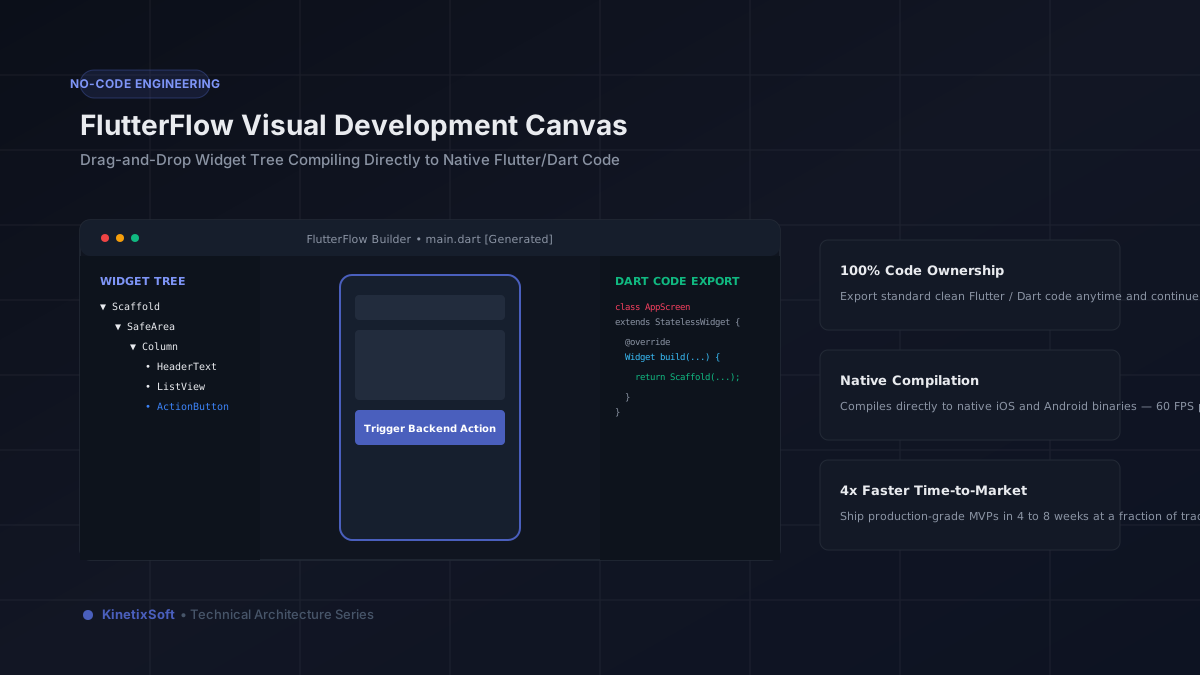
- Zero Technical Lock-In: Unlike legacy closed builders, platforms like FlutterFlow compile directly to open-source Google Flutter code that can be deployed on GitHub and compiled in standard IDEs like VS Code or Android Studio.
- Unified Cross-Platform Core: Write once and deploy natively to iOS, Android, Web, macOS, and Windows from a single reactive codebase.
3. Where FlutterFlow Fits in the Ecosystem
To choose the right tool for your project, understand where FlutterFlow sits on the development spectrum:
- No-Code Builders (Glide, Softr): Best for simple spreadsheet interfaces and internal CRUD directories. Highly limited in custom logic and app store distribution.
- Proprietary Web SaaS Builders (Bubble): Excellent for relational web databases and marketplaces, but logic runs on proprietary hosted infrastructure and cannot compile into native mobile binaries.
- Low-Code Visual IDEs (FlutterFlow): The modern standard for mobile and multi-platform apps. Compiles directly into standard Google Flutter (Dart) source code, supports local SQLite caching, Impeller GPU rendering, and complete private GitHub code synchronization.
- Pure Manual Native Code (Swift/Kotlin): Reserved for hardware-specific drivers, AAA mobile gaming, or low-level operating system modules.
4. The Typical FlutterFlow Engineering Architecture
A battle-tested FlutterFlow application follows a layered enterprise architecture:
Visual UI Layer (Flutter Widgets + Impeller GPU)
      │
      ▼
State Management (Widget State, Page State, Global App State)
      │
      ▼
Security & API Layer (Serverless Cloud Function Proxies - Zero-Trust)
      │
      ▼
Cloud Backend (Firebase Firestore / Supabase PostgreSQL + RLS)
      │
      ▼
Third-Party Engines (Stripe Payments, OpenAI LLMs, Brevo Notifications)
5. Advantages & Considerations
Key Advantages:
- Native GPU acceleration at 120 FPS on iOS and Android via Google Impeller.
- 100% legal code ownership with private GitHub repository export.
- Native Firebase Authentication, Cloud Firestore, and Supabase PostgreSQL integration.
- Extensible through custom Dart functions, custom actions, and custom pub.dev widgets.
Considerations & Best Practices:
- Never expose sensitive third-party API keys on the mobile client—always use Private API Groups routed through serverless Firebase or Supabase cloud function proxies.
- Enforce Role-Based Access Control (RBAC) via Firebase Custom Claims or Supabase Row Level Security (RLS) rather than client-side button hiding.
Got an App Idea? Validate It Before You Build
Not sure whether FlutterFlow, Bubble, or Lovable is right for your project? Talk to our senior architects at KinetixSoft about technical feasibility, database design, and MVP scoping before investing months of time.
Book A Free Scoping Call →